
AI Search Optimization (GEO & AEO): The Complete Guide for 2026
AI search optimization is the work of making your business easy for AI answer tools to find, understand and cite. Those tools include Google AI Overviews and AI Mode, ChatGPT search and Perplexity. This guide explains the terms, shows what actually matters, and gives you a 10-step plan and a 30-day checklist you can start this week. If you would rather have a team run it for you, our AI search optimization service covers the same ground.

Alt text: Illustration of a search box feeding an AI-generated answer that cites three business websites
AI image prompt
"Premium dark-theme technology illustration, 16:9. A glowing search bar at the left connects through flowing cyan and blue light lines to a large AI answer card in the centre, with three smaller source cards (website icons) linked beneath it as citations. Deep navy background (#080b14), cyan (#22d3ee) and blue (#3b82f6) accents, soft green (#4ade80) highlights on the citation links. Clean, minimal, corporate, subtle grid backdrop, no text, no logos, no people."
Quick answer
- What it is: Making your content the source that AI answers pull from, quote and link to.
- Is it new? Mostly no. Google says its AI features rely on the same ranking and quality systems as normal Search, so solid search engine optimization is the foundation.
- What's different: Success is a citation or mention inside an answer, not just a blue-link ranking.
- What works: Original, expert content; pages AI crawlers can reach and read; consistent facts about your business across the web; and regular testing.
- What doesn't: Tricks, fake reviews, and mass-produced pages. No one can guarantee placement in an AI answer.
What is AI search optimization?

Alt text: Diagram: a user searches "LED video wall on rent in Mumbai", the AI splits it into five related searches and combines the results into one answer that cites three websites
AI image prompt
"Clean flat infographic on a dark navy background: left, a user question bubble; centre, an AI engine node splitting the question into several smaller sub-questions (query fan-out); right, a single combined answer card with numbered citation chips linking to three website thumbnails. Cyan and blue line art, soft glow, rounded cards, no text except simple numbers 1, 2, 3, no logos."
AI search optimization is the practice of shaping your website, brand information and off-site presence so AI tools can retrieve, understand and cite you when people ask questions.
- Where it applies: Google AI Overviews and AI Mode, ChatGPT search, Perplexity, and similar answer tools.
- The goal: To be named, quoted or linked inside the generated answer.
- Other names: Generative engine optimization (GEO), answer engine optimization (AEO), AI SEO and LLM SEO. In practice these overlap heavily.
- How it relates to SEO: It builds on SEO. If a page can't be crawled, indexed and trusted, it won't be used in an answer.
GEO vs AEO vs AI SEO vs SEO
The terms are used loosely across the industry. This is how this guide uses them.
| Term | Aim | Typical output you chase | Notes |
|---|---|---|---|
| SEO | Rank pages in search results | Rankings, clicks, organic traffic | The foundation for everything below |
| AEO (answer engine optimization) | Be the direct answer to a specific question | Featured snippet, voice answer, AI Overview line | Works best for factual, question-style queries |
| GEO (generative engine optimization) | Be cited or mentioned in longer AI-written answers | Citations and brand mentions in ChatGPT, Perplexity, AI Overviews | Harder to measure; relies on clarity, accuracy and authority |
| AI SEO / LLM SEO | Umbrella phrase for SEO work aimed at AI tools | All of the above | Often used interchangeably with GEO |
Key points
- They are layers, not rivals. Most reputable guides agree GEO adds to SEO; it does not replace it.
- Google treats it as SEO. Its own guidance says optimizing for generative AI search is still SEO.
- Pick one primary term for your team. The tactics below work whichever label you use.
See the full comparison in our guide: GEO vs SEO vs AEO: what is the difference?
How AI search chooses its sources
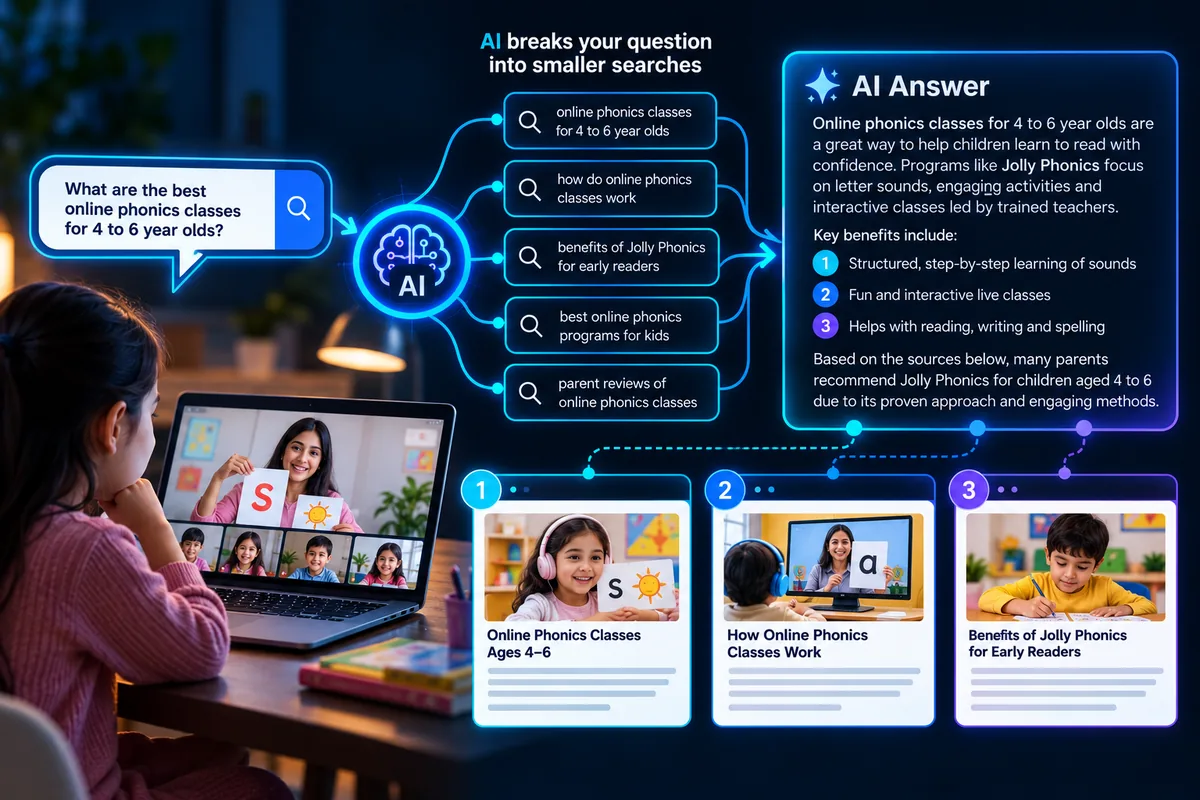
Alt text: Query fan-out diagram: one question about online phonics classes is broken into five smaller searches, then combined into a single AI answer with three cited sources
AI image prompt
"Minimal dark-theme diagram: one large question node on the left fans out with thin cyan lines into five smaller sub-question nodes, which then converge into one answer card on the right. Subtle grid background, rounded shapes, blue and cyan gradients, no readable text, no logos."
Different tools work differently, but the broad pattern is shared.
- Query fan-out: An AI system often breaks one question into several related sub-questions and searches for each. Covering the related questions around your topic gives you more chances to be selected.
- Retrieval: The tool fetches pages from a search index or its own crawler, then writes an answer from what it found.
- Eligibility comes first: For Google, a page must be indexed and eligible to show with a snippet. Even then, appearing is not guaranteed.
- Quality signals still count: Original, helpful content from a credible source is more likely to be used than a rewrite of what already exists.
- Rankings are not the only route. One Semrush study reported that most pages cited by ChatGPT ranked at position 21 or lower in traditional results, so a strong page can be cited without ranking on page one. Treat this as one vendor's finding, not a rule.
What Google says you don't need to do
A lot of AI-search advice online goes beyond what Google itself says matters. Google's official guide (Search Central) lists these as not needed for Google Search:
| Common advice | What Google's guide says |
|---|---|
Create an llms.txt file | Not needed. Google Search doesn't use it. It won't help or hurt Search visibility. |
| Add special "AI" schema markup | No special markup is required for generative AI search. Structured data is still useful for rich results. |
| Break content into tiny "chunks" | No chunking requirement and no ideal page length. |
| Rewrite pages for AI or chase every long-tail variation | Unnecessary. AI systems understand synonyms and intent. |
| Treat GEO/AEO as a separate discipline | Google treats it as SEO. |
| Get inauthentic mentions | Not helpful; spam systems are built to filter manipulation. |
| Publish many pages for query variations | This can break the scaled content abuse policy. |
How to read this
- Do the fundamentals first: crawlable, indexed, original, well-structured pages.
- Extras aren't harmful. Google says files like
llms.txtare fine to create for other services; they just don't help Google Search. Ktech's own site has one for AI assistants, but we don't claim it improves Google rankings. - Other platforms differ. ChatGPT and Perplexity have their own crawlers and retrieval, so access and off-site presence matter there (covered below).
How to optimize for AI search: 10 steps

Alt text: Roadmap of the 10 AI search optimization steps: crawler access, content, writing, site structure, business profile, off-site mentions, technical markup, local presence, updates and measurement
AI image prompt
"Horizontal roadmap infographic on a dark navy background with a glowing cyan path winding through ten numbered circular milestones (1–10), each with a simple line-art icon: lock/unlock, text lines, pencil, branching nodes, ID card, megaphone, code brackets, map pin, refresh arrows, magnifier. Blue and cyan gradient, soft glow, rounded, minimal, no text beyond the numbers, no logos."
Make sure AI crawlers and search engines can reach your pages
- Confirm key pages are indexable (no accidental
noindex, correct canonical tags). - Keep important facts and links in the raw HTML, not only loaded by JavaScript. A custom-coded business website with clean, semantic HTML makes this straightforward.
- Check your host or CDN isn't blocking legitimate crawlers.
- Make pages load quickly and show clear main content on mobile. Fast, reliable web hosting removes a common cause of slow or erroring pages.
Give the answer first
- Use question-style headings where a real question exists.
- Put a direct 1–3 sentence answer under each heading before the detail.
- Keep paragraphs self-contained so a sentence still makes sense if quoted alone.
- Use bullets and tables for steps, comparisons and criteria.
Publish content only you can write
- Add first-hand experience: what you saw, tested or measured.
- Include specifics: real numbers you own, named tools, real examples.
- Avoid summarizing what the top 10 results already say. Google's guide calls this "commodity" content.
- Add the author's name, role and a short bio.
Cover the related questions (query fan-out)
- List the follow-up questions a buyer asks after the first one.
- Answer each in its own short section on the same page, or on a linked page.
- Link related pages together with natural anchor text.
Keep your brand facts consistent everywhere
- Write a one-page fact sheet: legal name, services, address, phone, areas served, founding details you can verify.
- Match it across your site, Google Business Profile, social profiles and directories.
- Fix outdated or conflicting listings.
Build mentions beyond your own site
- Earn genuine coverage: industry write-ups, partner pages, client-approved case studies, local directories. Real creator and partner collaborations can also lead to honest mentions, which is where influencer marketing fits.
- Take part in communities where you can add real value (follow each platform's rules and disclose your affiliation).
- Collect real reviews from real customers. Never fabricate them.
Use structured data for what it's good at
- Add
Organization,LocalBusiness/ProfessionalService,Service,Article,BreadcrumbListandFAQPagewhere they match visible content. - Keep schema identical to what's on the page.
- Remember Google says there is no special schema for AI; it remains useful for rich results and machine-readable clarity.
Optimize your local and commercial details
- Complete and maintain your Google Business Profile.
- Keep services, hours, areas and contact details accurate.
- If you sell online, keep prices, stock and policies consistent between product pages and feeds. A well-structured online store makes that easier to maintain.
Keep important pages fresh
- Review your top pages every quarter.
- Update facts, dates, screenshots and examples; show a visible "last updated" date.
- Remove or merge pages that are thin or out of date.
Test, record, repeat
- Run a fixed set of real customer questions in AI tools (see the measurement section).
- Note whether you appear, how you're described, and who is cited instead.
- Fix the gap, then re-test.
Platform notes: AI Overviews, ChatGPT, Perplexity
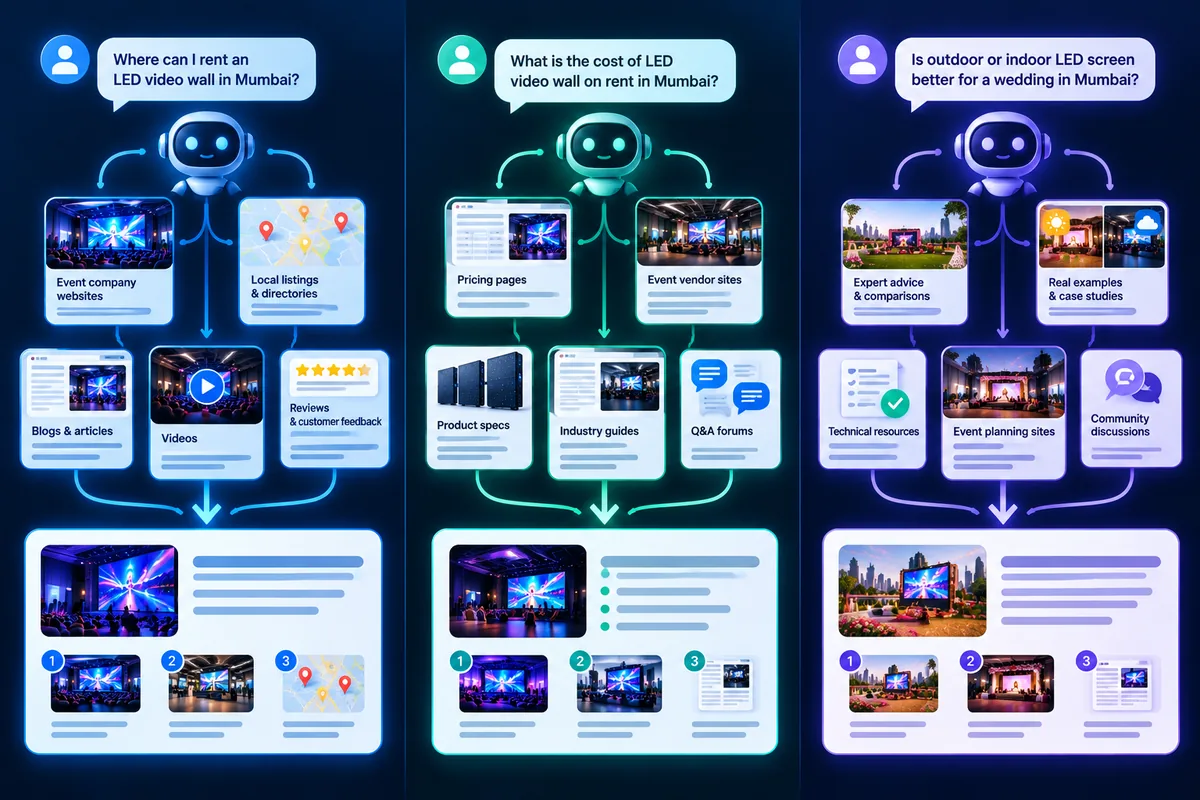
Alt text: Three AI answer examples side by side for LED video wall rental in Mumbai, showing how each question draws on different types of sources before one combined answer
AI image prompt
"Three vertical glass panels side by side on a dark navy background, each representing a different AI answer engine as an abstract chat/answer window, each with a different arrangement of small source cards and cyan connecting lines. No brand logos, no real product UI, abstract and generic, blue/cyan/green accents, minimal, premium."
How to appear in Google AI Overviews and AI Mode
- Start with eligibility: pages must be indexed and eligible to show with a snippet.
- Check the setting: in Search Console, Settings → AI controls → Search generative AI. Sites are included by default.
- Follow the helpful-content basics: original insight, clear structure, good images or video where they help.
- Use Google Business Profile and Merchant Center for local and product details.
- Measure with the Generative AI report in Search Console (see below).
How to get cited by ChatGPT
- Allow
OAI-SearchBot. OpenAI says sites that opt out of it won't be shown in ChatGPT search answers. - Allow OpenAI's published IP ranges at your host or CDN so the crawler isn't blocked.
- Publish clear, quotable, factual pages that answer a question directly.
- Expect no guarantee. OpenAI states placement is not guaranteed.
- Remember the 24 hours. Robots.txt changes can take about a day to take effect.
Perplexity and others
- Tools differ in which index they use and how they cite, so test each platform you care about.
- Semrush's guide recommends tailoring to each platform's retrieval method rather than assuming one tactic fits all.
AI crawlers and robots.txt
Different bots do different jobs. Blocking the wrong one can remove you from answers; allowing the wrong one may let your content be used for training.
| Bot | Run by | What it does (per OpenAI's documentation) | If you block it |
|---|---|---|---|
OAI-SearchBot | OpenAI | Surfaces websites in ChatGPT search | Your site isn't shown in ChatGPT search answers (may still appear as a plain link) |
GPTBot | OpenAI | Collects content that may be used to train OpenAI's models | Signals your content shouldn't be used for training |
ChatGPT-User | OpenAI | Visits a page when a user asks ChatGPT about it; not an automatic crawler | Doesn't decide whether you appear in ChatGPT search |
Semrush's guide also lists CCBot, ClaudeBot, Claude-User and Claude-SearchBot among the crawlers worth checking in your robots.txt.
A simple, transparent robots.txt approach
# Allow normal crawling and ChatGPT search
User-agent: *
Allow: /

User-agent: OAI-SearchBot
Allow: /

# Optional: opt out of model training (a business decision, not an SEO requirement)
# User-agent: GPTBot
# Disallow: /

Sitemap: https://example.com/sitemap.xml- Decide deliberately. Allowing search crawlers and blocking training crawlers is a policy choice for you to make.
- Test after changing. Allow about 24 hours, then re-check.
- Don't rely on robots.txt alone to protect private content.
How to track AI search visibility

Alt text: Dashboard concept for tracking AI search visibility: a grid of test questions against five AI platforms with check marks showing where a brand appears, beside trend charts
AI image prompt
"Dark-theme analytics dashboard concept, abstract: a grid of rows (questions) and columns (platforms) with small cyan check dots and grey empty dots, a small bar chart and a simple line trend on the right. Rounded glass cards, navy background, cyan/blue/green accents. No real numbers, no real brand logos, no readable text."
1. Run a prompt test (free, repeatable)
This method is adapted from Aleyda Solis's AI search checklist.
- Pick 30–50 real questions your customers ask. Start smaller if you're a small business.
- Run each one 3–5 times in the same short window, because answers vary.
- Log: platform, date, country/location, language, whether you appear, how you're described, which links are shown, and which competitors appear.
- Treat the numbers as starting points. The 30–50 prompts and 3–5 runs are suggested baselines, not proven benchmarks.
2. Use Google Search Console's Generative AI report
- Shows: impressions for pages in Google's generative AI experiences, by page, country, device and date.
- Doesn't show: the individual queries, or a split between AI Overviews and AI Mode.
- May not appear until a property has enough generative AI impressions.
- Be careful with third-party tools that claim access to Google's internal metrics.
3. Watch AI referral traffic in analytics
- Look for visits from AI tools in your analytics referral reports.
- Treat AI referral conversions as a floor: some AI-influenced visits arrive as direct or branded searches.
- Make the visits you do get count. Clear calls to action, faster pages and simpler forms are the focus of conversion rate optimization.
- Report presence, readiness and business impact as separate measures; label estimates as estimates.
AI search optimization for Mumbai and Indian businesses
This section is practical guidance, not market data. We haven't published India-specific AI-search statistics because we couldn't verify any from a reliable source.
- Make "near me" and area intent obvious. Mention the neighbourhoods you serve (for example Borivali, Andheri, BKC, Powai) in headings and copy where it's true and useful.
- Fix your local listing first. Google Business Profile optimization feeds local answers and is named in Google's own guidance.
- Test in the language your customers use. Run prompts in English, Hindi and Hinglish, and from a Mumbai location, then note differences.
- Keep name, address and phone identical on your site, Business Profile and local directories.
- Show real local proof you can verify: the real office, real service areas, real client permissions. Skip anything you can't back up.
- Link your service pages to your guides so AI tools and visitors find the detail behind each claim.
Want a Mumbai team to handle this? Ask about our AI search visibility work for Mumbai businesses or book a free consultation.
A 30-day plan for small businesses

Alt text: Four-week AI search optimization plan: week 1 audit, week 2 business profile and entity details, week 3 content updates, week 4 review and repeat, ending in a completed check mark
AI image prompt
"Four glass cards in a row on a dark navy background labelled with simple week icons (1–4): a magnifier, an ID card, a pencil on a page, a refresh arrow. A thin cyan line connects them left to right with a small green check at the end. Minimal, rounded, premium, no text beyond numbers, no logos."
All free tools, no new software required.
Access and baseline
- Check key pages are indexed and not blocked.
- Review robots.txt for
OAI-SearchBotand other bots. - Write your 30 test questions and run the first prompt test.
- Verify Google Search Console and check the AI controls setting.
Fix the facts
- Write your one-page brand fact sheet.
- Make your site, Google Business Profile and directories match it.
- Add author names and bios to your key pages.
Improve the pages that matter
- Rewrite your top 5 pages to answer first, then explain.
- Add one original element to each: your own data, a real example, a photo.
- Add missing FAQ content that mirrors real customer questions.
- Check structured data matches the visible page.
Extend and re-test
- Earn or request two genuine mentions (a partner page, a local listing, an industry write-up).
- Re-run the prompt test under the same conditions.
- Record what changed and choose next month's three actions.
Mistakes and tactics to avoid
- Fake reviews, planted mentions or "manufactured" community posts. They can backfire and damage trust.
- Hiding instructions for AI in your pages (prompt injection). Don't.
- Mass-producing pages for every keyword variation. Google's guide names this as scaled content abuse.
- Blocking every AI bot by default and then wondering why you're missing from answers.
- Copying competitors' content or rewriting the top results.
- Treating AI search as separate from SEO. It sits on top of it.
- Making claims you can't prove, such as "#1" or guaranteed placement.
- Believing any provider who promises guaranteed AI citations.
What AI search optimization can't promise
- No guaranteed placement. Both Google and OpenAI say inclusion isn't guaranteed.
- Citations move. Semrush's AI Visibility Index reported that 40–60% of cited sources changed month to month, so track trends rather than single results.
- Measurement is partial. Several metrics are proxies or estimates.
- Evidence is still developing. Even the best frameworks are practitioners' methods, not proven formulas.
- Not every business needs every tactic. Start with the fundamentals and the questions your customers really ask.
How our services support AI search visibility
AI search optimization is not one task. It draws on several parts of a digital marketing plan, and each has its own page if you want the detail.
- Rankings and crawlability: the foundation is SEO that fixes technical issues and builds content, because AI tools mostly pull from pages that search engines already trust.
- Direct AI-focused work: testing prompts, fixing brand facts and improving answer-ready pages is what our AI search optimization team does day to day.
- Local answers: "near me" and area questions lean on an accurate Google Business Profile.
- The site itself: clean markup, speed and clear structure come from professional website development, and from e-commerce website development for online stores.
- Turning visits into enquiries: once AI tools send visitors, conversion rate optimization helps more of them get in touch.
- Paid and social support: when you need visibility while organic work builds, Google Ads and Meta Ads can fill the gap, though they don't influence AI answers directly.
Frequently asked questions
Still have a question? Ask our teamIt is the practice of making your website and brand information easy for AI answer tools to find, understand and cite. It covers Google AI Overviews and AI Mode, ChatGPT search and Perplexity. It builds on SEO rather than replacing it.
SEO aims to rank pages. AEO aims to be the direct answer to a question. GEO aims to be cited or mentioned in longer AI-written answers. Most guides treat them as overlapping layers, and Google treats all of it as SEO.
No. AI features rely on core search systems, so crawlability, indexing and quality still come first. GEO adds attention to citations, brand consistency and off-site presence.
Make pages crawlable and indexed, answer questions directly, publish original expert content, keep brand facts consistent everywhere, earn genuine mentions, and test regularly. The 10 steps above set this out in order.
Allow OAI-SearchBot in robots.txt, make sure your host isn't blocking OpenAI's IP ranges, and publish clear, factual pages that answer real questions. OpenAI says placement is not guaranteed.
Your page must be indexed and eligible to show with a snippet, and your site must be included in the Search generative AI setting in Search Console. Then focus on original, helpful content. Google says inclusion is never guaranteed.
Not for Google Search. Google's guide says it doesn't use llms.txt and that it won't help or hurt Search visibility. You can still create one for other services.
Google says no special schema is required for AI search. Structured data remains useful for rich results and for describing your business clearly, as long as it matches the visible page.
Run a fixed set of real customer questions in AI tools, log whether and how you appear, use the Generative AI report in Search Console, and watch AI referrals in analytics. Treat results as trends, not exact figures.
Yes, in focused areas. Specific local knowledge, accurate listings and genuinely original content don't require a large budget. Results aren't guaranteed, and no one can promise a particular placement.
There is no fixed timeline. Technical fixes can be picked up within days, while content and reputation work builds over months. Re-test monthly and after major platform changes.
Blocking search crawlers such as OAI-SearchBot removes you from that tool's answers. Blocking training crawlers such as GPTBot is a separate business decision about how your content is used.
Go deeper: the guides in this series
- What is Generative Engine Optimization (GEO)?
- GEO vs SEO vs AEO: what is the difference?
- How to get cited by ChatGPT, Gemini and Perplexity
- The AEO checklist
- AI Overviews and click-through rate: what the data shows
- Schema markup for AI search: what helps and what does not
Related services
Sources9 references · tap to open
- Google Search Central — Optimizing your website for generative AI features on Google Search
- Aleyda Solis — The AI Search Optimization Checklist
- Semrush — How to optimize for AI search results
- Search Engine Land — What is generative engine optimization (GEO)
- Conductor — What is Generative Engine Optimization
- OpenAI — Overview of OpenAI crawlers
- OpenAI Help — Searching the web with ChatGPT
- TechWyse — How to measure AI search visibility in Google Search Console
- WSCubeTech — SEO vs AEO vs GEO
Ready to find out where you stand?
Ktech Media Solutions runs an AI search visibility audit for businesses in Mumbai: we test the questions your customers ask, show who is being cited instead of you, and give you a prioritised fix list. Talk to our team or read how our AI search visibility audit works.