

ChatGPT Ads in India: A Practical Guide for Businesses
ChatGPT Ads are paid, labelled placements shown below some ChatGPT answers. They reached India in late August 2026. This guide separates what OpenAI has confirmed from what is only reported, explains how campaigns work, and shows how to prepare before spending. It is written for business owners and marketers in India.
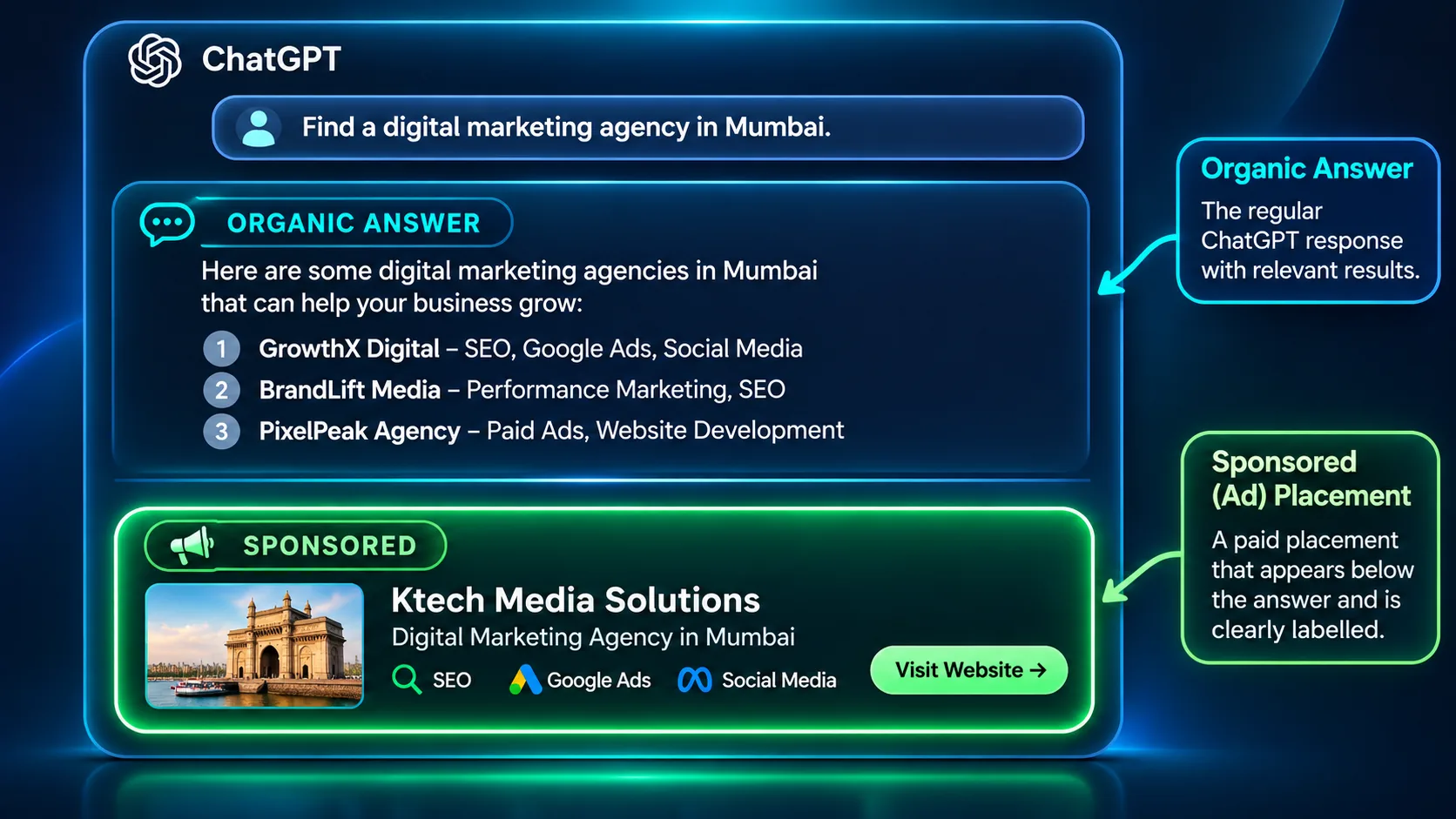
Alt text: ChatGPT mockup with an organic answer listing digital marketing agencies in Mumbai and a separate green Sponsored placement below it, with labels explaining the difference
AI image prompt
"16:9. A generic chat answer panel built from soft text bars, with a clearly separate glowing green sponsored card placed beneath it and a thin divider between the two. A small shield icon suggests clear labelling. Premium dark-theme technology illustration. Glass cards, soft glow, cyan (#22d3ee), blue (#3b82f6) and green (#4ade80) accents on a deep navy (#080b14) background. Clean, minimal, high contrast, no readable text or statistics, no real brand logos, no fabricated ChatGPT or ad interface."
Quick answer
- Short answer: Yes. ChatGPT Ads went live in India in late August 2026 for logged-in adults on the Free and Go tiers. Paid tiers are ad-free.
- How to buy: through OpenAI’s self-serve Ads Manager or an agency. Reports differ on when self-serve opened, so check your own account.
- Cost: the documented minimum is ₹725 per day. OpenAI has not published India CPC or CPM averages, and we do not invent them.
- Not the same as organic: ads sit below the answer, labelled. They do not make ChatGPT recommend you inside it.
- Replace Google Ads? No. Treat it as a capped test next to Google and Meta.
- Date checked: 5 November 2026. Policies and access change, so verify before you spend.
What are ChatGPT Ads?
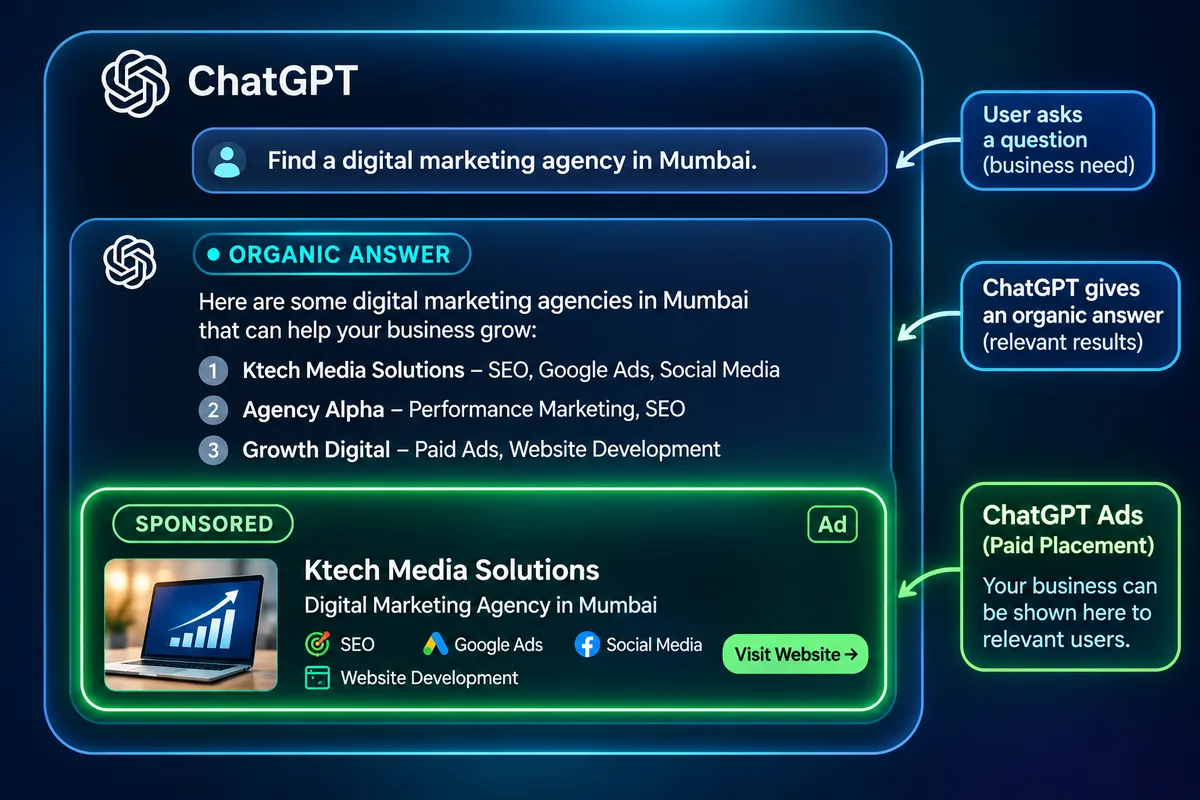
Alt text: Annotated ChatGPT mockup: a user question, an organic answer listing agencies, and a labelled Sponsored ad placement below the answer
AI image prompt
"3:2 annotated mockup of a chat window: question, organic answer panel, labelled sponsored card below, three callouts. Premium dark-theme technology illustration. Glass cards, soft glow, cyan (#22d3ee), blue (#3b82f6) and green (#4ade80) accents on a deep navy (#080b14) background. Clean, minimal, high contrast, no readable text or statistics, no real brand logos, no fabricated ChatGPT or ad interface."
ChatGPT Ads are paid, labelled placements that OpenAI shows to some ChatGPT users. They are advertising, not a ranking. A business pays to appear; it does not earn a mention in the answer itself.
- Where they appear: below a ChatGPT response, when the system finds a relevant sponsored product or service. Launch coverage describes them as labelled sponsored and visually separate from the answer.
- Who sees them (India): logged-in adults on the Free and Go tiers. Plus, Pro, Business, Enterprise and Education subscribers stay ad-free (as reported by exchange4media on 27 August 2026).
- What advertisers get: aggregate performance data such as impressions and clicks. Advertisers do not receive the underlying conversations or personal details (as reported).
- What they are not: they do not make ChatGPT recommend your brand inside an organic answer. For that, see AI search optimization or our AI search optimization service.
Are ChatGPT Ads available to advertisers in India?
Yes, with caveats on how you buy. Ads went live in India in late August 2026. What we can and cannot confirm differs by claim, so the table separates them. Date checked: 5 November 2026.
| Claim | Status | Source type |
|---|---|---|
| Ads are live in India for logged-in adults on Free and Go | Reported by multiple outlets; announced 27 Aug 2026 | News (exchange4media) and trade press |
| Minimum daily campaign budget is ₹725 | Listed in OpenAI’s help centre (INR 725 among example minimums) | OpenAI help centre |
| Self-serve Ads Manager is open to Indian businesses | Reported: launch coverage said 4 Sep 2026; a 1 Sep report says self-serve launched; a third-party tracker said none at launch | Conflicting. Verify in your own account |
| WPP and Omnicom are first agency partners (non-exclusive) | Reported at launch | News (exchange4media) |
| Over 50 brands going live in the first week | Reported at launch; brands not named | News |
| Sector exclusions specific to India | Global ad policy is published; India-specific rules not separately confirmed by us | OpenAI ad policies |
- Why the dates conflict: coverage between 27 August and 1 September gives different answers on when self-serve opened. We do not pick one. Sign in and check.
- How to check access: open the OpenAI ads sign-in used by advertisers, complete business verification and billing, and look for the India market and INR billing in the account. If self-serve is not available to your account, ask OpenAI’s ads team or an authorised agency.
- What stays unconfirmed: India-specific CPC or CPM averages. OpenAI has not published them, and neither will we.
How does ChatGPT advertising work?
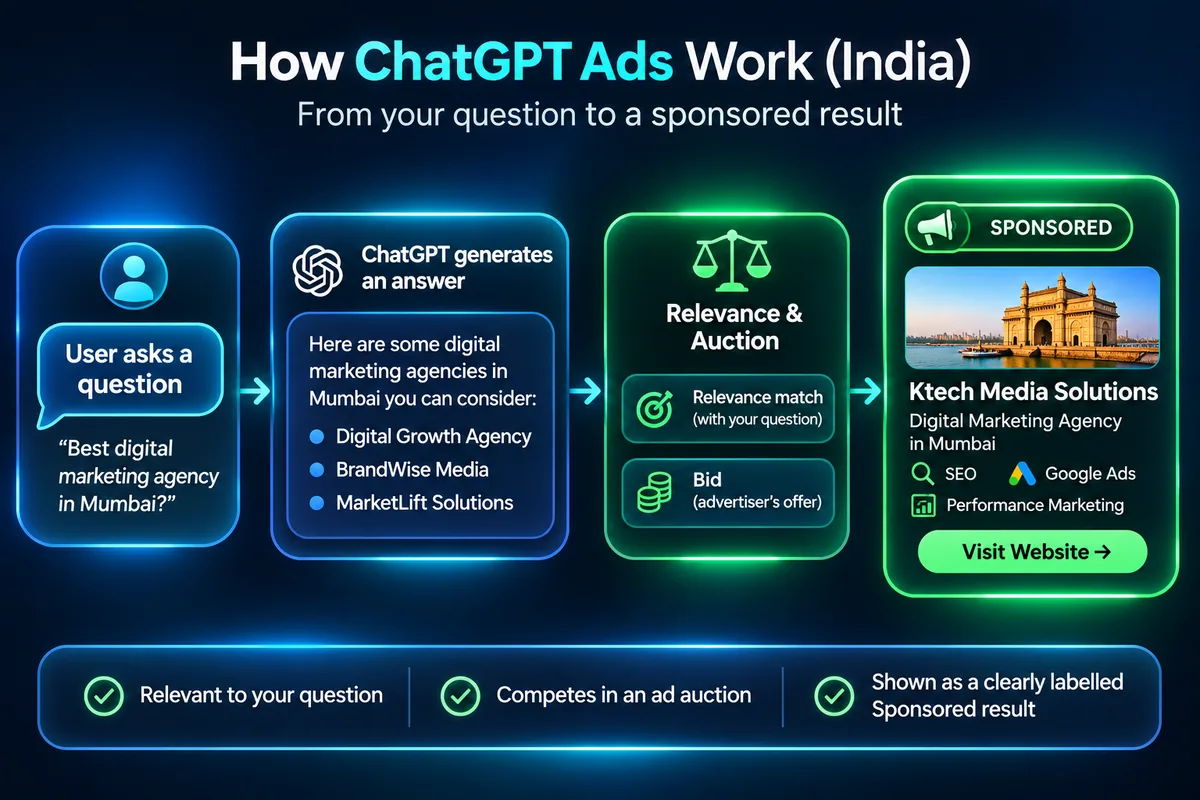
Alt text: Four-step diagram: a user asks a question, ChatGPT generates an answer, relevance and an auction decide the ad, and a labelled Sponsored result appears below the answer
AI image prompt
"3:2 flow diagram. Four glass nodes left to right: a question bubble, an answer panel, a relevance and auction gate with a scale icon, and a labelled sponsored card. Glowing connector lines. Premium dark-theme technology illustration. Glass cards, soft glow, cyan (#22d3ee), blue (#3b82f6) and green (#4ade80) accents on a deep navy (#080b14) background. Clean, minimal, high contrast, no readable text or statistics, no real brand logos, no fabricated ChatGPT or ad interface."
- Context, not keywords: the system looks at the conversation to decide whether a sponsored result is relevant. Marketers describe it as search having keywords, social having audiences, and AI offering context.
- Auction: reported as a relevance-weighted, second-price auction in which your bid is one factor alongside relevance. A higher bid alone does not guarantee delivery.
- Context hints: upGrowth reports that ad groups use plain-language descriptions of the conversations you want to appear in, rather than keyword lists. This comes from one agency’s own account; confirm it in yours.
- Order of events: the answer is generated first; the ad appears below it (as reported). That is why a weak organic mention of your brand can undercut an ad: you may be paying to argue with the answer.
How to prepare and launch a campaign
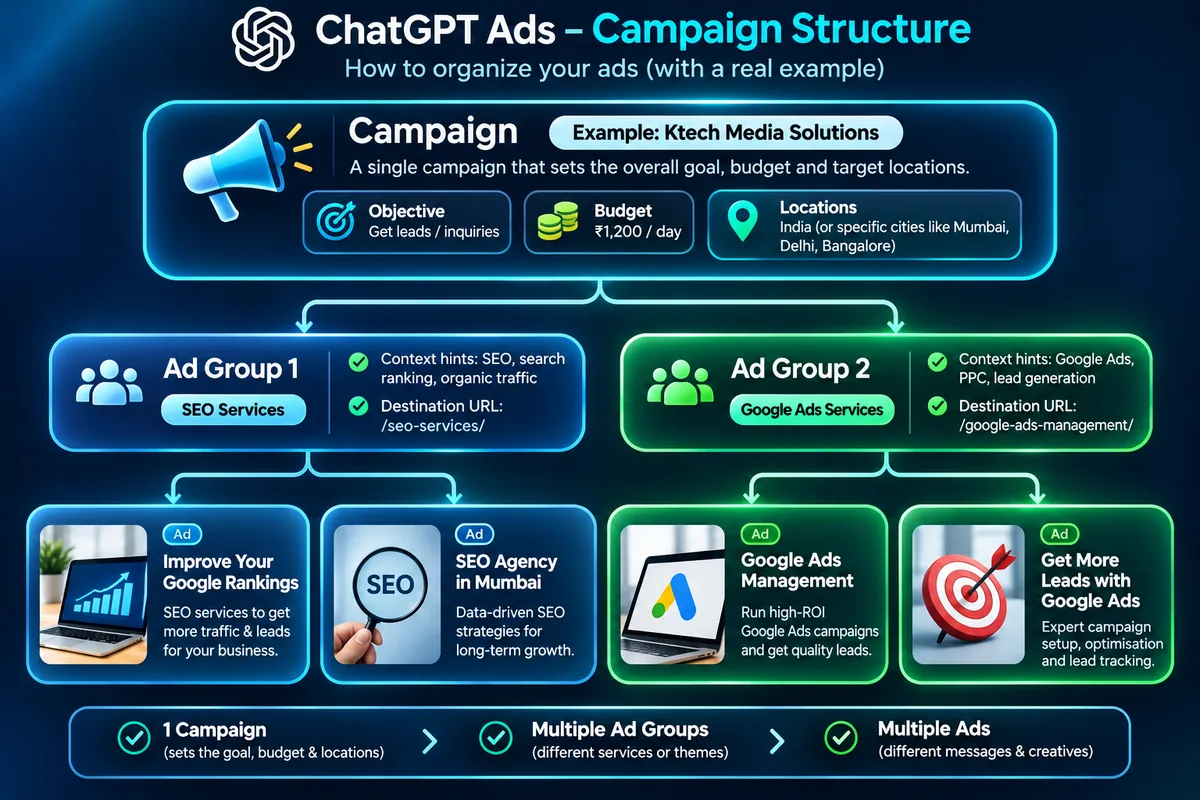
Alt text: ChatGPT Ads campaign structure example: one campaign with objective, budget and locations, two ad groups with context hints and destination URLs, and two ads under each group
AI image prompt
"3:2 hierarchy diagram. One large glass card at the top (campaign) branching to two mid-level cards (ad groups) that each branch to two small cards (ads). Icons only, no readable text. Premium dark-theme technology illustration. Glass cards, soft glow, cyan (#22d3ee), blue (#3b82f6) and green (#4ade80) accents on a deep navy (#080b14) background. Clean, minimal, high contrast, no readable text or statistics, no real brand logos, no fabricated ChatGPT or ad interface."
OpenAI’s help centre describes the campaign structure. The steps below follow it, with preparation first.
| Level | What you set | Notes |
|---|---|---|
| Campaign | Name, objective, budget, start and end dates, countries, optional platforms and custom audiences | Objective cannot be changed after creation. Use separate campaigns for separate goals or regions |
| Ad group | Bidding approach, context hints, destination URL (as reported in agency walkthroughs) | Use several ad groups to test themes and messages |
| Ad | Headline and description | One agency reports 50 and 100 character limits. Check in Ads Manager |
- Objectives (OpenAI help centre): Views are billed per 1,000 impressions (CPM). Clicks are billed per valid click (CPC). Conversions optimise toward a supported conversion event, billed by valid clicks or by impressions. You do not pay per conversion.
- Budgets: a campaign-total budget caps spend over the campaign. A daily budget is a seven-day average target: daily spend will not exceed twice your daily budget, and weekly spend will not exceed seven times it. The budget week runs Sunday to Saturday in your account time zone.
- Targeting: include India explicitly; exclusions alone do not restrict delivery. Platforms can be chosen (Android and iOS app and web, desktop web). Custom audience inclusion needs at least 25,000 matched users.
- Before you build: match every landing page to the ad (our website development team builds these), fix page speed, set up conversion tracking, and read the ad policies. Ads go live only after account verification, billing and review.
- Start with Clicks: several practitioners suggest running Clicks until conversion tracking is verified, then moving to Conversions. Treat that as a practice, not a rule.
ChatGPT Ads pricing and budgeting
- Documented floor: the minimum daily budget in India is ₹725 (OpenAI help centre, repeated in launch coverage).
- Billing models: CPM, CPC and conversion-optimised CPC are reported. Pricing follows the objective you choose.
- No official India benchmarks: we found no OpenAI-published India CPC or CPM average. Some blogs quote ranges without a source. We do not repeat them.
- Global signals, not India: exchange4media reports early US inventory around $60 CPM, falling to about $45 within weeks, with some deals at $25–$35, and OpenAI guidance suggesting starting CPC bids of $3–$5. A bid ceiling is not an average price. Do not convert these into rupee forecasts.
- What marketers say: Indian brand leaders quoted in trade press expect to experiment first, and say any premium must come from incremental outcomes rather than novelty.
Illustrative budgeting (hypothetical, not a benchmark). These figures show arithmetic only.
| Scenario | Daily budget | Days | Total | What it tells you |
|---|---|---|---|---|
| Technical floor | ₹725 | 30 | ₹21,750 | Enough to launch; probably too little data to judge a result |
| Hypothetical learning test | ₹2,000 | 14 | ₹28,000 | Two weeks to test two or three messages; choose your own number |
| Hypothetical phase two | Set after test | — | — | Scale only if enquiries are qualified and tracked |
Set a stop rule before you start: the spend at which you pause, and the result that justifies more. Daily budgets can overspend up to twice on a single day, so cap total spend on tests.
ChatGPT Ads vs Google Ads and Meta Ads
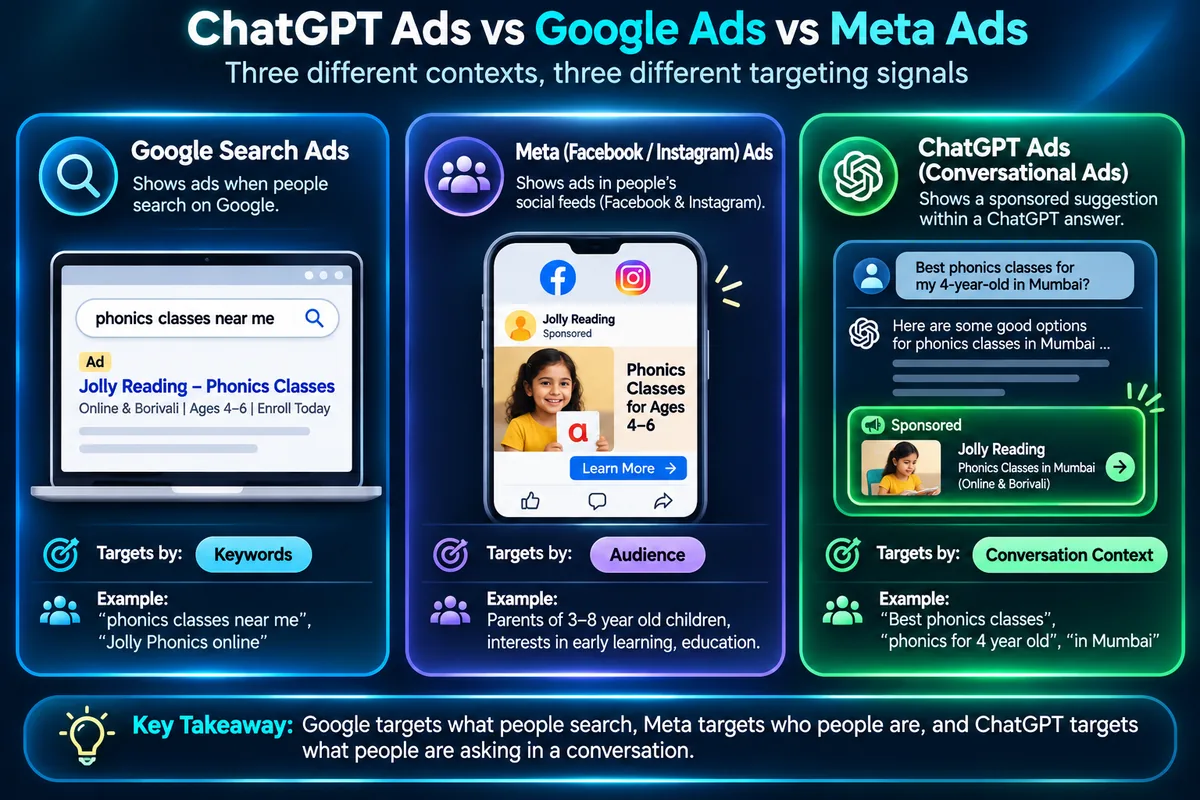
Alt text: Comparison of Google Search Ads targeting by keywords, Meta Ads by audience and ChatGPT Ads by conversation context, each with an example
AI image prompt
"3:2 three-column comparison. Left column a magnifier (search), middle a group of people icons (social), right a chat bubble (conversational). Same card style for each, equal visual weight. Premium dark-theme technology illustration. Glass cards, soft glow, cyan (#22d3ee), blue (#3b82f6) and green (#4ade80) accents on a deep navy (#080b14) background. Clean, minimal, high contrast, no readable text or statistics, no real brand logos, no fabricated ChatGPT or ad interface."
| Factor | Google Ads | Meta Ads | ChatGPT Ads |
|---|---|---|---|
| Main signal | Search keywords and intent | Audiences and interests | Conversation context |
| Maturity in India | Established, deep data | Established, deep data | New; launched August 2026 |
| Best for | Capturing existing demand | Creating demand and retargeting | Testing high-consideration research moments |
| Reach in India | Broad | Broad | Free and Go logged-in adults only |
| Reporting | Detailed | Detailed | Reported as aggregate, campaign-level; still early |
| Role in a plan | Core | Core | Test budget alongside core channels |
- Not a replacement: ChatGPT Ads cannot replace Google Ads today. The audience is limited to two tiers, reporting is early and the channel has no track record in India.
- Where it may fit: research-heavy purchases where people compare options in conversation. Trade press expects early interest in insurance, real estate and education, though policy limits apply to some of these.
- Run it separately: keep ChatGPT spend in its own test line so it does not blur your Google and Meta results. We run these channels through our Google Ads and Meta Ads services.
Industry use cases in India
These are opportunities to test, not promised results. Check each against the ad policy first.
| Sector | Test idea | Watch for |
|---|---|---|
| E-commerce and D2C | Product-comparison and gift-finding conversations. Align the ad with one product or collection page on your e-commerce website | Consumer goods is a launch category. Claims must match the landing page |
| Real estate | Early research on locality and budget. Send people to a project page with clear details | Check category rules and RERA-related claims with your legal adviser |
| Education and coaching | Course and exam-preparation research. Send to a programme page, not the home page | Education is a launch category. Avoid guarantees of results |
| B2B and SaaS | Tool comparison and “which software for” questions. Offer a demo or comparison page | Digital products are a launch category. Qualify leads before you judge cost |
- Restricted for now: financial services, healthcare and legal services are listed as approved-advertiser or case-by-case categories in OpenAI’s policy.
- Not allowed: categories such as gambling, crypto, dating and recreational drugs are prohibited. Read the full list in the policy section below.
Measuring campaign performance
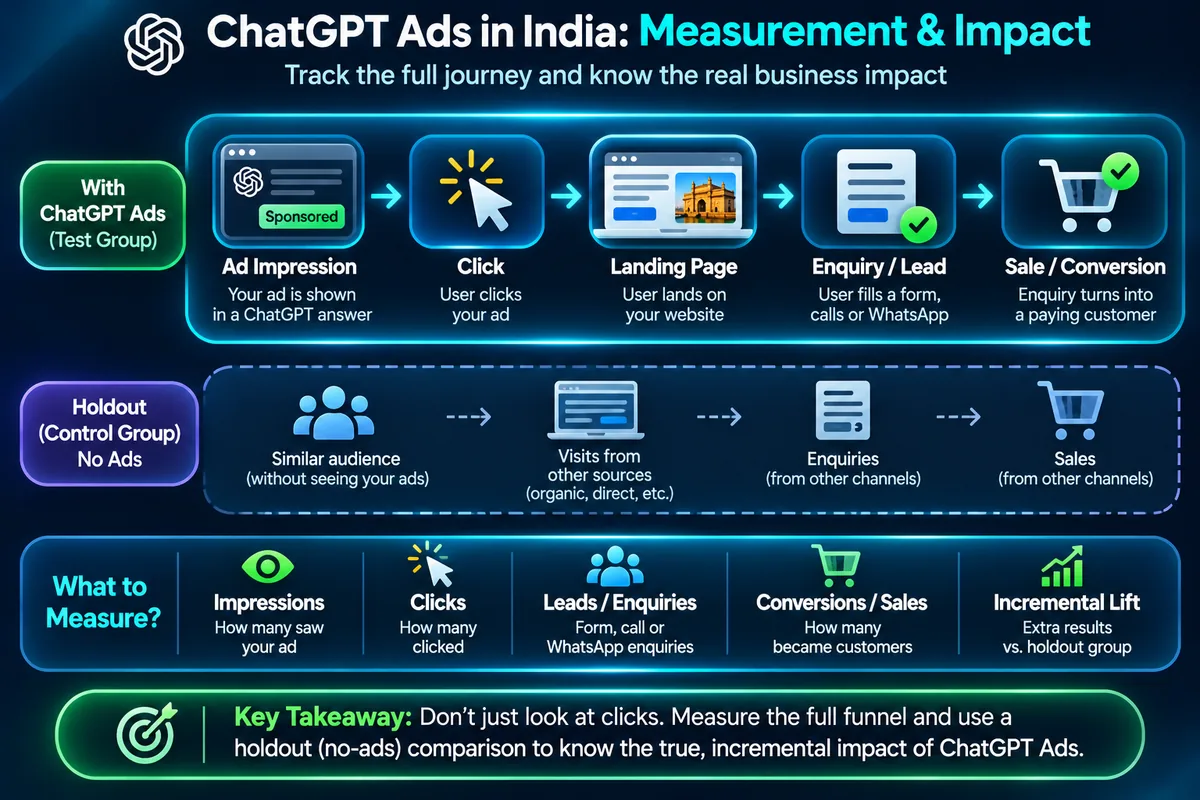
Alt text: Measurement flow from ad impression to click, landing page, enquiry and sale, compared with a no-ads holdout group, plus a list of what to measure
AI image prompt
"3:2 funnel diagram. Impression, click, landing page, enquiry and sale as five connected glass nodes, with a second dashed path labelled by an icon for a holdout comparison. Premium dark-theme technology illustration. Glass cards, soft glow, cyan (#22d3ee), blue (#3b82f6) and green (#4ade80) accents on a deep navy (#080b14) background. Clean, minimal, high contrast, no readable text or statistics, no real brand logos, no fabricated ChatGPT or ad interface."
- What reporting shows: impressions, clicks, spend, CTR, average CPC, average CPM and conversions are reported. Insights can be segmented by platform.
- What it does not show: user-level data. Marketers quoted in trade press describe reporting as aggregated and campaign-level, which makes attribution the hard part.
- Your own tracking: add UTM parameters to destination URLs, track enquiries and sales in GA4 or your CRM, and tag leads by source. Do not rely only on in-platform conversions.
- Incrementality: ask whether the sale would have happened anyway. Compare against a period or region without ChatGPT spend where you can.
- Judge by cost per qualified enquiry: clicks alone mislead on a new channel with a different audience mix. Improving what happens after the click is conversion rate optimisation.
Policies, privacy and brand safety
The points below come from OpenAI’s published ad policies (page updated 4 June 2026, read 5 November 2026). Policies change, so check the live page before you plan.
- Prohibited categories include: adult content, alcohol and tobacco, counterfeit goods, crypto and debt services, gambling, political content, recreational drugs, scams, and unsupported wellness claims.
- Restricted (approved advertisers, case by case): financial services, healthcare and legal services.
- Claims: ads must be truthful. Exaggerated results, false endorsements and unfounded claims about pricing, outcomes or comparisons are prohibited.
- Consistency: ad copy, creative and landing page must agree, and the landing page must match the product shown.
- Placement: ads are not shown in sensitive contexts such as mental health, self-harm, political content or emotionally reliant conversations. Medical, legal and financial advice contexts are no longer categorically blocked by default, but sensitive conversations remain ineligible.
- Review: automated screening plus human review for borderline cases. Ads or pages that cannot be reviewed are not eligible to run, and repeated violations can lead to account suspension.
- Privacy: advertisers receive aggregate data, not conversations. The ad policy page itself sets out no data-collection rules; read OpenAI’s privacy and advertising terms for those.
Common mistakes and readiness checklist
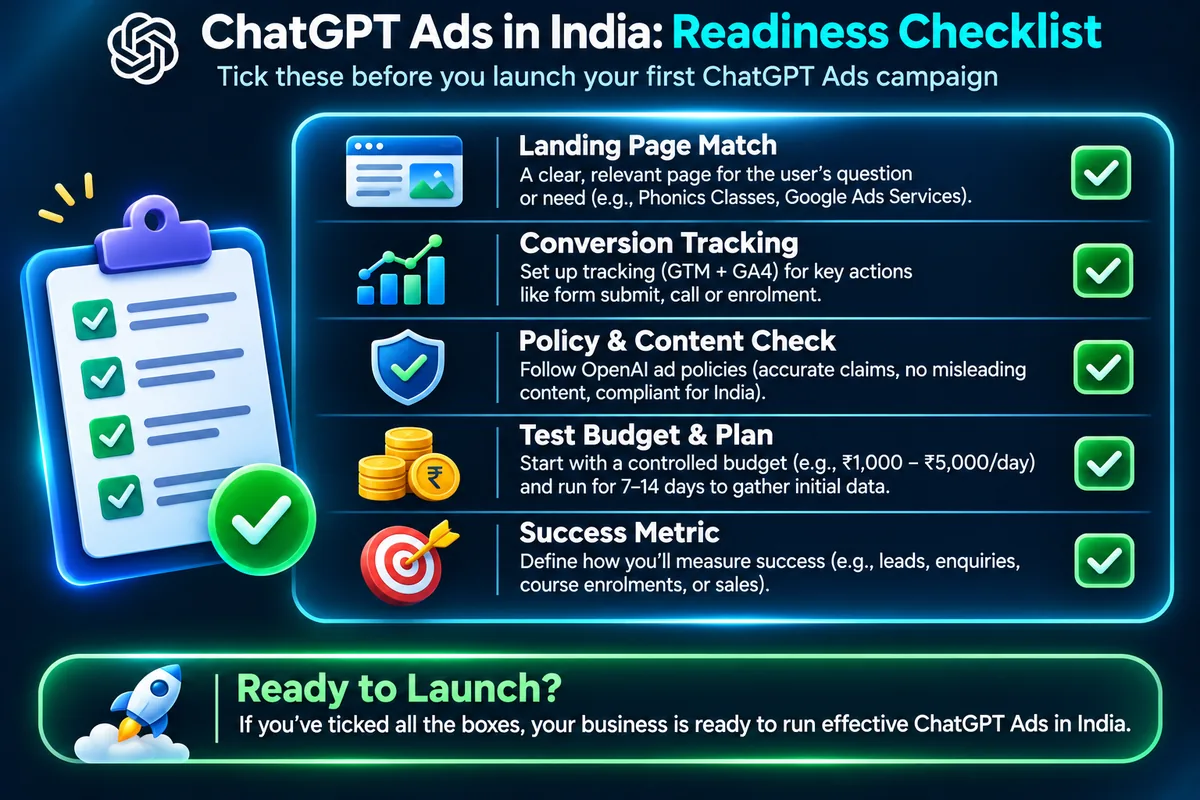
Alt text: ChatGPT Ads in India readiness checklist: landing page match, conversion tracking, policy check, test budget and plan, and a success metric
AI image prompt
"3:2 checklist infographic. A glass card with five rows of tick marks and abstract line placeholders, a green progress bar at the bottom. No readable text. Premium dark-theme technology illustration. Glass cards, soft glow, cyan (#22d3ee), blue (#3b82f6) and green (#4ade80) accents on a deep navy (#080b14) background. Clean, minimal, high contrast, no readable text or statistics, no real brand logos, no fabricated ChatGPT or ad interface."
- Sending traffic to the home page. Use a page that matches the ad and the question behind it.
- Launching without tracking. If you cannot count enquiries, you cannot judge the test.
- Copying Google keyword lists. Context hints describe conversations, not search terms.
- Trusting unsourced benchmarks. Plan from your own data.
- Assuming ads fix a weak brand presence. If the answer does not support you, the ad has to work harder.
- Ignoring policy. A rejected ad or page costs weeks.
Readiness checklist
- ☐ Business verification and billing ready for INR
- ☐ One landing page per ad group, matching the ad claim
- ☐ Page speed and mobile layout checked
- ☐ UTM tags, GA4 events and CRM source field in place
- ☐ Ad copy checked against the ad policy
- ☐ Test budget, end date and stop rule written down
- ☐ One success metric agreed, such as cost per qualified enquiry
- ☐ Someone owns weekly review
When should a business seek campaign support?
- You have no tracking in place and cannot say which channel produces enquiries.
- Your landing pages do not match your offers or load slowly on mobile. We fix this through website development and conversion rate optimisation.
- You sell in a restricted category and need to check eligibility before spending.
- You want a controlled test with a budget cap, a stop rule and a clear read-out.
- You already run Google Ads or Meta Ads and need to keep results separate.
Ktech Media Solutions can review campaign readiness, align landing pages and set up conversion measurement. We do not promise results on a new channel.
Frequently asked questions
Still have a question? Ask our teamYes. Ads went live for logged-in adults on the Free and Go tiers in late August 2026, according to launch coverage. How you buy them is less settled: reports differ on when the self-serve Ads Manager opened to Indian businesses, so check your own account. Date checked: 5 November 2026.
Sign in to the OpenAI advertiser account, complete business verification and billing, and look for India targeting and INR billing. If you cannot create a campaign, ask OpenAI’s ads team or an authorised agency. Launch coverage named WPP and Omnicom as first agency partners.
The documented minimum daily budget in India is ₹725. Beyond that, cost depends on your objective (CPM, CPC or conversion-optimised CPC) and the auction. We found no official India CPC or CPM averages, so we do not quote any. Plan from a small test, not from a blog benchmark.
No. Ads are paid, labelled placements shown below an answer. Organic visibility means ChatGPT mentions or cites your brand inside the answer itself. You can have one without the other. Our guide to AI search optimization covers the organic side.
Not today. ChatGPT Ads reach only logged-in Free and Go users, reporting is still early and the channel is new in India. Treat it as a test budget alongside Google and Meta, not a substitute.
Logged-in adults on the Free and Go tiers. Plus, Pro, Business, Enterprise and Education subscribers stay ad-free, as reported at launch. That means reach skews away from paying subscribers.
Launch coverage says ads appear below an answer that has already been generated, and OpenAI’s policy requires ads to be clearly distinguishable from ChatGPT. We have not seen a more detailed statement from OpenAI, so we do not claim more than that.
Advertisers are reported to receive aggregate performance data such as impressions and clicks, not individual conversations or personal details. Read OpenAI’s current privacy and advertising terms for the exact wording.
OpenAI’s ad policy prohibits categories such as adult content, alcohol and tobacco, gambling, crypto, political content and recreational drugs. Financial services, healthcare and legal services are restricted to approved advertisers. Check the live policy before you plan.
Not necessarily. Buying is reported to be possible through the self-serve Ads Manager or agency-managed campaigns. An agency or consultant helps most with landing pages, tracking and test design, which matter more than the account setup.
Go deeper
- AI search optimization (GEO & AEO): the complete guide for 2026 — the organic side of AI visibility
- How to get cited by ChatGPT, Gemini and Perplexity
- GEO vs SEO vs AEO: what is the difference?
- SEO services — the organic foundation that paid tests rely on
- Website development — landing pages that match your ads
- Conversion rate optimisation — turn clicks into enquiries
- Google Ads services — search campaigns with proper tracking
- Meta Ads services — Facebook and Instagram campaigns
Sources9 references
- OpenAI — Ad policies (updated 4 June 2026; read 5 Nov 2026)
- OpenAI Help — Create campaigns for ChatGPT Ads
- exchange4media — OpenAI rolls out ChatGPT Ads in India (27 Aug 2026)
- exchange4media — ChatGPT Ads just hit $1bn run rate. Now comes the price test in India (1 Sep 2026)
- exchange4media — Search had keywords, social had audiences: can ChatGPT sell context? (28 Aug 2026)
- Relevant Audience — ChatGPT ads reach 41 markets; India opens with no self-serve buying (third-party tracker)
- TelecomTalk — ChatGPT Ads launched in India, budgets start
- Analytics Insight — How much it costs to run ChatGPT Ads in India
- upGrowth — ChatGPT Ads Manager setup guide for India (agency, own-account findings)
Date checked: 5 November 2026. Facts marked “reported” come from news or agency sources and may change. OpenAI’s help-centre announcement pages could not be loaded during our check, so we rely on the published ad policy, the campaign help article and trade coverage.
Planning to test AI advertising?
Speak with Ktech Media Solutions about campaign readiness, landing-page alignment and conversion measurement.